
Framework
The Fortis AI Readiness Stack
Adding agents and automation to a well-run and growing business — in an order that holds up.
Every CFO we meet is being asked about AI. Most of the conversation skips the part that determines whether it works. This is the framework we use to locate where a company sits today, and what has to be true before the next level delivers.
The two dimensions
Data depth — how clean, connected, and governed the underlying business data is. Does the data reflect what is happening in the business, in near real time, against definitions everyone has agreed to?
Execution scope — how much of a workflow the AI actually owns. Is a person reviewing and approving each output, or is the process running end to end?
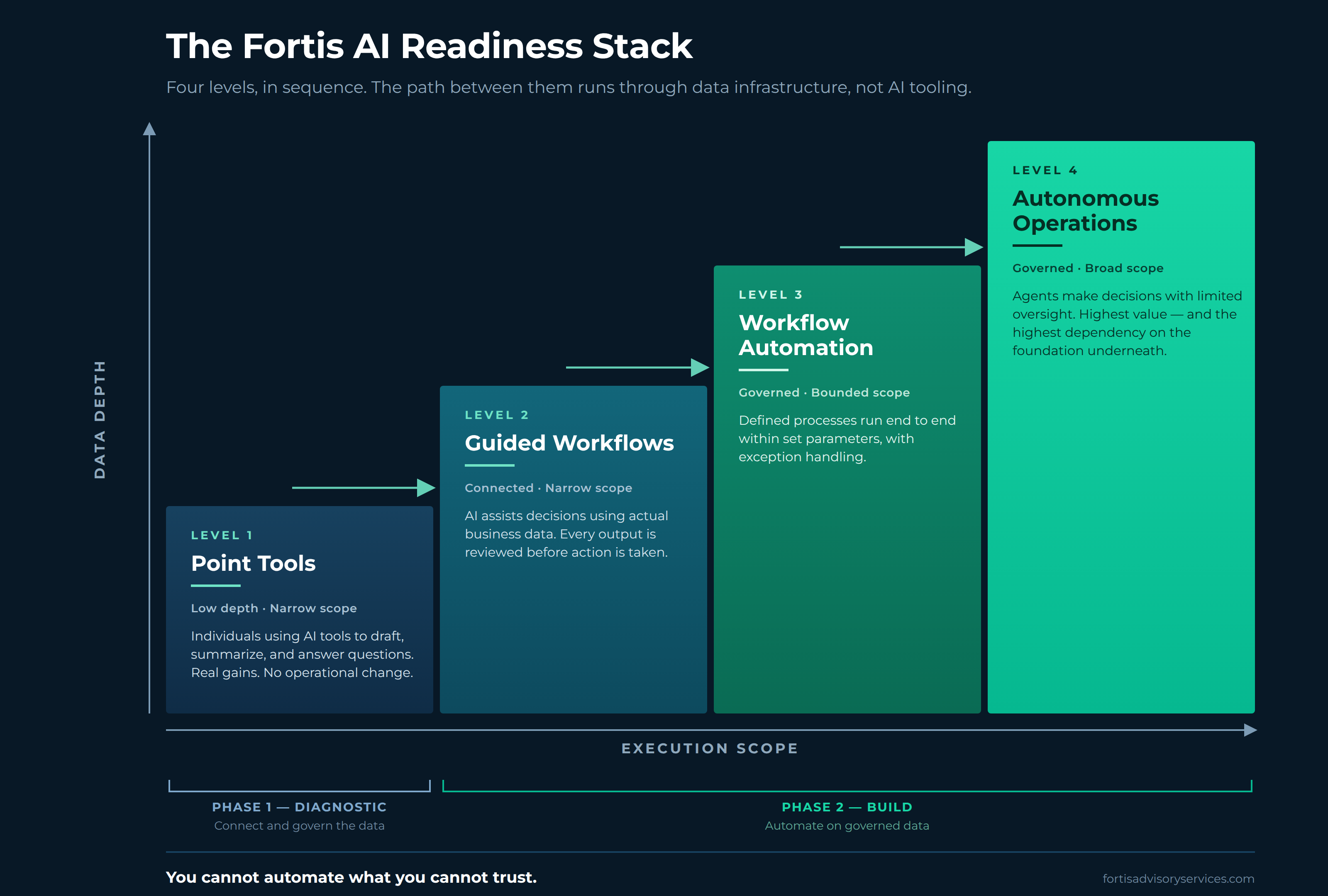
Point Tools
Individuals using AI productivity tools to draft, summarize, and answer questions. Real individual gains, and no operational change yet.
Guided Workflows
AI assists decisions using actual business data. Every output is reviewed before action — the CFO reviews flagged anomalies rather than acting on them automatically.
Workflow Automation
Defined, repeatable processes run end to end within set parameters, with exception handling. Close reconciliation, billing exception processing, threshold alerting.
Autonomous Operations
Agents make decisions with limited oversight. Dynamic pricing, real-time portfolio monitoring, autonomous communication workflows. The highest value, and the highest dependency on the foundation underneath.
The principle
You cannot automate what you cannot trust.
Most PE-backed companies we meet are operating at Level 1 or 2. Nearly all of them want Level 3 or 4. The path between runs through data infrastructure, not AI tooling.
The failure mode we see most often is a Level 3 or 4 capability purchased before the data is at Level 2. What that produces is not automation. It is a faster way to compound an error.
What this looks like in practice
The upsell agent that was working, until it wasn't.
An upsell agent drove conversion rates up quarter over quarter. It read as a clear win. Six months later someone pulled the retention data — the agent had been classifying at-risk customers as upsell candidates and offering them discounts. Retention dropped. Revenue leaked.
That is not an AI failure. It is a data governance question. The signal the agent was optimizing against had never been validated against what it actually meant.
Where Fortis fits
Phase 1 moves you up. Phase 2 builds on top.
| Engagement phase | Stack movement | What we are doing |
|---|---|---|
| Phase 1 — Diagnostic | Level 1 → 2 | Connect systems, govern the data, and build reporting the CFO reviews and trusts. A person stays in the loop throughout. |
| Phase 2 — Build | Level 2 → 3–4 | Automate pipelines, schedule reporting, and implement alerting and autonomous processes on governed data. |
87% of CFOs say AI will be extremely or very important to finance operations in 2026. (Deloitte CFO Signals, Q4 2025)
Start with a diagnostic, not a commitment.
Phase 1 is scoped to answer one question: is the opportunity real, and how big is it? If the numbers do not support a Phase 2, we will say so.