
How we work
Four layers, built in order.
Turning raw data into trustworthy answers happens in four distinct layers. Skipping any of them produces confident-sounding answers that do not hold up under questioning.
The Data Capability Pyramid
Most initiatives skip from Layer 1 to Layer 4.
A warehouse and a BI tool are bought, and answers are expected. The two layers in between are where the answers actually come from.
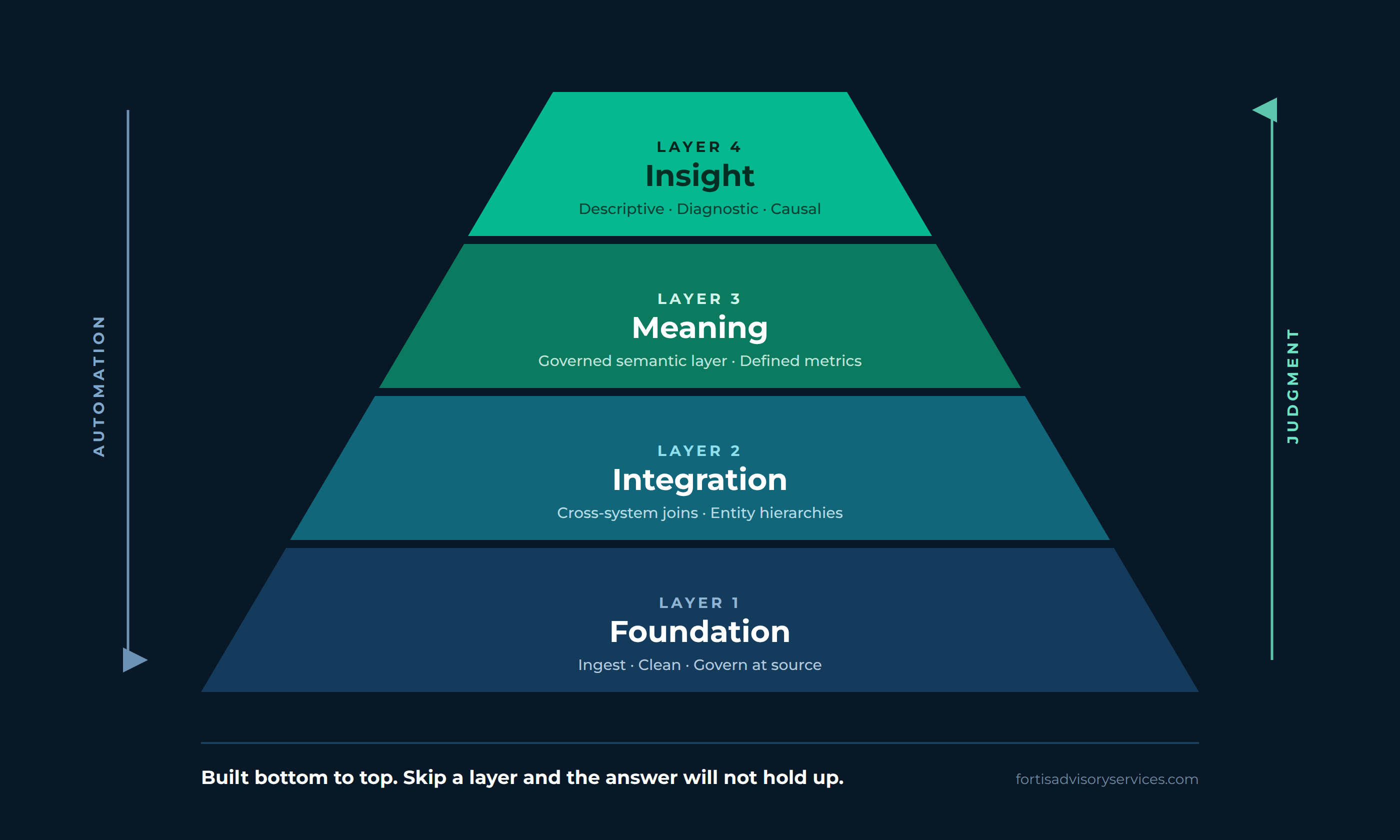
Foundation
Connecting the systems of record and landing the data reliably, with soft-delete hygiene, close-calendar logic, and currency translation handled at source rather than patched downstream.
Integration
Customer, item, and entity hierarchies reconciled across systems that each define them differently. Labor hours joined to revenue. The join keys that make a combined answer possible.
Meaning
One definition per metric, owned by a named person, version-controlled and citable. This is where the CFO's role is changing: definitions finance owns hold only when operations co-authors them, so we build this layer with both in the room.
Insight
The questions the business actually asks. Which customers make money, why they leave, where price can move. Reachable only when the three layers underneath are built.
Up the pyramid, automation gets thinner and judgment gets thicker.
Delivery
Four workstreams, one operational arc.
Money out, money in, books closed, business understood. Built on the systems of record you already run.
AP & Vendor Operations
Invoice through payment, with the vendor master deduplicated and authoritative across entities. Coding and exception triage on your existing AP system.
Quote-to-Cash
Contract to cash application, auditable revenue recognition, and receivables aging signals connected to a named-owner action loop.
Close & Reconciliations
A faster, signed-off close. Intercompany eliminations and constant-currency variance native to the semantic layer.
Reporting & Forecasting
An auto-assembled weekly business review, cross-tab consistent, with the forecasting path chosen in writing.
The 100-day path
Four milestones, then stabilization.
Urgency preserved, with real time for validation, change management, and the inevitable surprise that source systems differ from the data model.
Day 1–30 · Foundation laid
Systems connected. Master entity model scoped and first cross-system joins live. First 10–15 metrics defined and tested. Scope and sequencing signed.
Day 31–60 · Semantic layer in production
Thirty to forty core metrics defined and tested. First automated workflow live on the existing system. First parallel close run. Weekly review drafted alongside the existing pack.
Day 61–90 · First production close
First production close run on the new foundation, targeting a materially shorter cycle. Reporting cutover to the auto-assembled review. Initial revenue and margin opportunities surfaced and quantified.
Day 91+ · Stabilization and reassessment
Second production close as the gate. Forecasting workstream initiated. Any headcount discussion deferred to a 120–150 day window, with three cycles of evidence behind it.
What stays human
The senior team is redirected, not replaced.
Five categories of work stay with a named person by design. Capacity returns to judgment, which is what the outcomes require.
Reserves and revenue recognition
Bad debt, warranty, and returns reserves. Multi-element arrangements, variable consideration, contract modifications. The system calculates; a person owns the call.
Strategic financial analysis
M&A diligence review, value-creation analytics, pricing strategy, capital allocation. The work the foundation is built to enable.
Authorization and approval
Payment authorization, journal entry approval, accruals sign-off, payroll authorization. Where audit standards require a named person, that person takes responsibility.
Compliance and external reporting
Tax returns, audit responses, regulatory disclosures, board commentary. Tools accelerate the work; they do not absorb the responsibility.
Exception handling at the long tail
The small share of cases the systems do not handle cleanly. The system surfaces, people resolve, the model learns, and the tail shrinks.
Working principles
How we hold ourselves to it.
Reconciliation to the ledger is the acceptance test
A margin model is not finished when the reporting looks right. It is finished when it ties to the general ledger and the variance is explained.
Deliverables stay live, not hard-coded
Our models keep the raw data as the only fixed input. Every summary above it stays formula-driven, so your team can audit the arithmetic rather than trust it.
Agree a tolerance instead of chasing zero
We formalize the monthly tie-out from operational data to the ERP with a stated tolerance per metric, so variances are explained rather than discovered.
Every claim is labeled by where it came from
Verified, client-sourced, or inferred. We do not blur those together, and we will tell you when the data does not support the conclusion you were hoping for.
We build for handoff, not dependency
The engagement is successful when your team does not need to backfill our role. Documentation and training are scope, not an afterthought.
Nothing gets ripped out
We work in the stack you already own. Where your current tools are the right ones, we say so and move on.
Start with a diagnostic, not a commitment.
Phase 1 is scoped to answer one question: is the opportunity real, and how big is it? If the numbers do not support a Phase 2, we will say so.